Categories
exploration hiking travel

the road to sarybash

1508-roadtosaribas-blog-titlepic-womenvalleyThis was the most the most expensive and hard-earned lunch I’ve ever had. I didn’t pay for it, but I’m in pain and it took over 4,000 kilometres on planes, buses, taxis and on foot to get to it. And here I am in the remote mountain village of Sarybash on the far edge of Azerbaijan, the culmination of a journey six months in the making that all started with stumbling across this place on Google Earth.

Remote inhabited places fascinate me—the farther and harder the reach the better. I need to know who lives there and why. Is it due to lack of better options, or because it is the best option? To get away from everything, or to find something? I can relate to all of these questions, for they all ask the same thing: why do I go anywhere?

No more questions, I knew right away I must go to Sarybash.


It’s not an easy road. The closest town reachable by public transport is Ilisu, 10km away. Then your only options are by horse, 4-wheel drive or on foot. The dirt path twists up and down the sides of a deep canyon and crosses the river twice. Just as you think you’ve made headway climbing, the path plunges cruelly down to the riverbed, erasing your progress.

1508-roadtosaribas-blog-5877thehiddenvillage-

The start of my journey, at the far edge of the canyon, sunlight reflects from a lone building in Sarybash.

Of course it couldn’t be too easy.


But I made it. As I approach the final bend to the village, the gatekeeper greets me. Well, a gate fixer to be precise. He’s fifty or so, a tough looking and unshaven working man dressed for warmth and with three sheep in tow. Before I could catch his name, he starts his interview whilst fixing the gate. “Where are you from? How did you get here? How do you know Russian?” Against my father’s advice (who is convinced everyone wants to kill Russians) I recite my usual answer: my grandparents were Russian and I learned it when I was little. His face brightens and he laughs, telling me it’s funny that an American who lives in England who knows Russian has found his way up there. Yes, I think—it is quite funny. He finishes his task and heads down the hill, his sheep dutifully following him. I wish him a good day, feeling quite surprised by just how un-surprised he was to run into me. This would set a precedent. 1508-roadtosaribas-blog-05485welcomecomittee

I make the final push. The air is chilly, but I am sweaty. Everything hurts and I just want to rest. It’s strange how after you push yourself through so much, you are so wiped out that you forget why you did it.


The guide

At the summit I stumble upon an unexpected expanse of bright green stretching from the cliffs behind me to the Dagestan (Russia) border to the north. It’s called the Tala, which used to be a field for both football and helicopters back in the USSR days.

1508-roadtosaribas-blog-05528-talagreenlawn

Dagestan border—a no-go zone crawling with soldiers, smugglers, outlaws and general troublemakers.

I limp towards a statue overlooking the canyon. Its shadow makes for a perfect resting spot to enjoy the view.

1508-roadtosaribas-blog-05512statue-ilisuview

Far away to the south where the river ends is Ilisu, my starting point.

But a young, casually dressed man pops up, seemingly levitating from under the cliff edge. The sight snaps the tired out of me. And I’m more surprised to see him than he is of me. He is curious and friendly. My Russian is as useless to him as his Azerbaijani is to me. But impromptu sign language and image searches on his phone work well. His name is Mehemmed, which I find out from becoming his Facebook friend within minutes.

Mehemmed

He follows me as I make my way to the cliff edge. We stare at the road I climbed in silence for a while. When I stand up, he stands up too. I know he will go anywhere I go for the rest of the day. And that’s OK.

Mehemmed senses I’m here with a camera and a purpose.

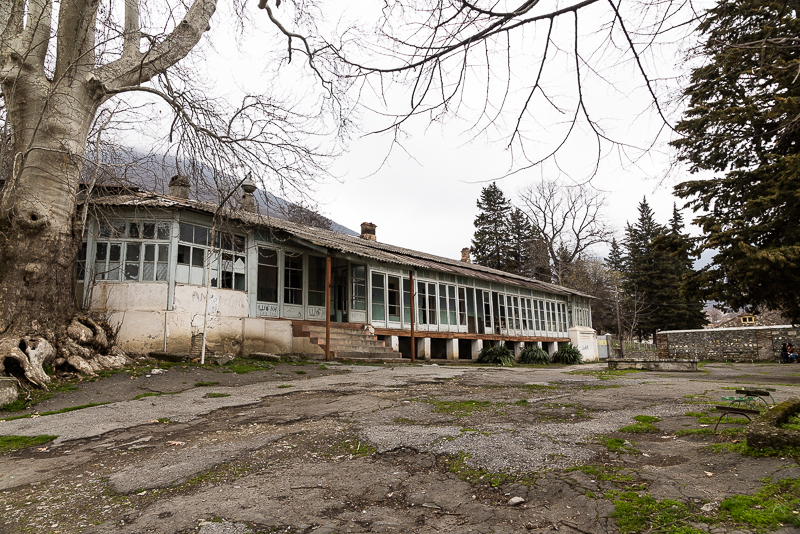
He sees a captures my interest. But he’s not sure why. Because it looks like an abandoned prison hospital, that’s why. So we go in.


The teacher

This bleak, sawdust-stinking place full of faded portraits of mustached military men just had to a relic of the Soviet government. But I was wrong.

1508-roadtosaribas-blog-05532-evidenceschool-desks

My search yields broken desks and dirty rooms littered with yellowed posters displaying the joys of maths, geography and art.

A very large school for a very small town. But no signs of children.

1508-roadtosaribas-blog-5573-mahiresroomThe smell of burning wood grows stronger. Is this place on fire? We find a comfortably shabby room that looks like a museum crossed with a squat. A bed, stove and recently dated newspapers. I’m astonished—somebody lives here. Perhaps an eccentric with a passion for textbooks and solitude?

The occupant swooshes past me from behind, sits at the desk, opens her book and starts scribbling. She’s smiling and smirking, amused by my presence. You can read intelligence by how people themselves read—fast, intense, absorbing knowledge. And it clicks. She’s a teacher. But no, not a teacher—she’s the teacher. The only one.

It’s clear Mehemmed is explaining who I am. I know that she wants to speak with me. But there’s no common language between the three of us. However, I do learn her name is Mahire. She’s interested that I’m interested and shows me without words how the old seismometer on her desk works. She was born to teach.

Mahire, the sole teacher in Sarybash. © Nicholas Orloff.

“Kids?” I ask in Russian. Mahire shrugs.

“They’re gone.”

I remembered it was Novruz, and of course they wouldn’t be there. But from what I was about to learn from Zahir, in some years time what she said will most likely mean something more dire.


Lunch at last

1508-roadtosaribas-blog-05623-gullu-looking

Gullu keeping an eye on Zahir.

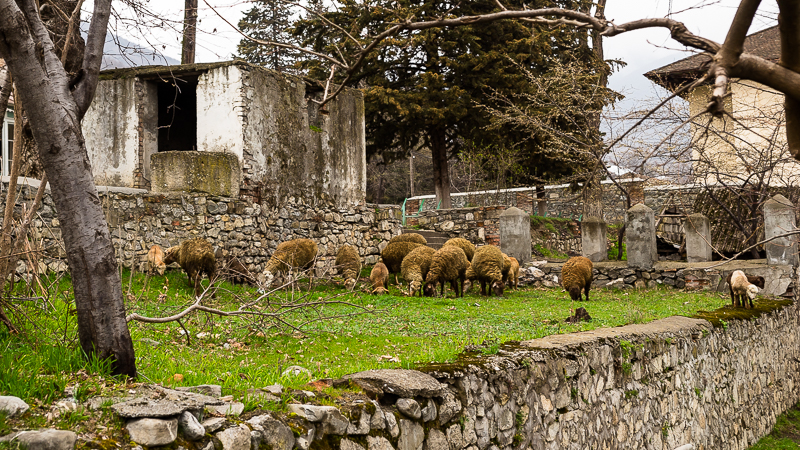
Gullu, a lady of about 80, greets us as we pass her window whilst keeping an eye on her husband, Zahir.  She shouts at him to stop chasing cows and come say hello. He is a proud, humorous and warm man, and just from how he shook my hand I’d pick him to be mayor of this village. 76 years old and a fluent Russian speaker, it was welcome to meet someone I can communicate with easily and who could translate as well.

1508-roadtosaribas-blog-05623-zahir-chasingcows

Zahir keeping an eye on his cows.

Within minutes Mehemmed and I are sitting at their dinner table. Their home is a good size, comfortable and warm. The news plays through static on an old 13-inch . I’m surprised they get reception up here. Small talk, chitchat and eating make up the afternoon. Heaps of fragrant rice, fresh baked bread and home made yoghurt, stewed chicken and colourfully pickled, well, .

It’s all delicious and made with care, reminiscent of dinners I used to have with my grandparents thirty years ago. This was home for an hour.

1508-roadtosaribas-blog-05604-dinnertime

Mehemmed and Zahir break bread.

Nicholas Orloff - Having lunch with friendly locals. They are so relaxed, as if they’ve invited strangers into their home hundreds of times. They probably have. He teases Gullu and laughs a lot. He teases me too, asking me if I can dance or sing for them. “Oh Nikolai, Nikolai…” he would say after recounting an anecdote, reflecting on life’s absurdities. He was my grandfather for the hour as well.

Zahir tells me that the people who stay are growing older and the young are leaving sooner, as the country’s capitol, Baku, has too many opportunities. Once over 1,000 people lived here. Now only 100 or so. The only road in or out is eroding and there’s no sign the government will improve it. Work revolves around herding cows and sheep, but it’s not clear how one makes a living from that. Government pensions are about 100 manat (£75) per month. But it seemed like a relaxing and satisfying life—one I could get used to. But I have the privilege to leave whenever I want.

After politely refusing vodka (a dozen times), I leave with a full stomach and with them a promise to them to send their photos.


I am grateful for Mehemmed’s patience for having a friend along for the day was welcome. At my insistence we pull ourselves up a steep hill behind the town, taking care to not slip on the rocks and using slender tree trunks as hand grips. It was worth it:

1508-roadtosaribas-blog-05630-rooftop-viewsaribas2

The view from above Sarybash.

And then we descend to explore the village, covering every corner within an hour. The cold March wind blowing through the empty streets is the only sound we hear.

Thick chimney smoke signals and are the only clues that people live here. I’ve seen a lot of decay in Azerbaijan, from abandoned hospitals to hammans and homes. But there is always new construction nearby. But in Sarybash, and falling apart, a sign this village has been given up on. There isn’t the will or the resource to demolish anything, and if it were fixed, how many would use it, and for how long?

I don’t feel like an explorer here, just someone who had the fortune of experiencing the last of something. Mutual curiosity is a powerful thing; it breaks down barriers whether cultural, linguistic or geographic. The people I met all shared with me the idea of Sarybash before it’s gone.


1508-roadtosaribas-blog-selfie-endIt may seem ridiculous to read that I came all the way to Azerbaijan to spend an afternoon in this place. But Sarybash wasn’t the sole purpose, but the glue holding the trip together. It’s a challenge that gives the journey structure and focus by building anticipation before, and accomplishment for reflection after.

So of course I didn’t travel all that way, go through all of that hassle, spend all of that time and money, and suffer aches, scrapes and bruises simply to have climbed to this tiny village high up in the mountains to chat with strangers I’d never know I’d meet. That would be crazy, I would never do that on purpose for a free lunch.

Or perhaps I did.


Would you like to take the road to Sarybash?
Follow my journey and see photos along the way in this interactive map.

1508-roadtosaribas-blog-05694-largewhitegovernmentalbuilding

1508-roadtosaribas-blog-05595-tippy-statictelly

1508-roadtosaribas-blog-05597-tippy-dontknoweating
1508-roadtosaribas-blog-05670-flag-laundry-signals
1508-roadtosaribas-blog-05666-mosque
Categories
exploration travel

urban exploration in sheki, azerbaijan

Nicholas Orloff. A photo of a sad face drawn on the wall of an abandoned children's hospital. It wasn’t until I realised that all of those empty bottles never held vodka that I was deep inside a complex that held hundreds of sick children many years ago.
When you realise what something is something else, you see everything differently.

So why the hell am I in this place:

Exterior shot of one of the abandoned buildings in the complex.

instead of this place, which is right next door?

Palace of the Shaki Khans, Sheki Azerbaijan - taken by Nicholas Orloff, 2015.

Palace of the Shaki Khans, Sheki Azerbaijan.

Because I can’t resist.

One of the benefits of slow travel is finding things you didn’t know you were looking for. It’s worth walking miles with pain and sweat, getting lost and spending time and energy to hit dead ends, all to eventually stumble across places like this. Around the corner from that beautiful palace you see above, I found it: this complex of derelict buildings up the hillside.

150501-sheki-abandoned-childrens-hospital-blog-hospital complex-1

Stepping from the sunshine into the dark and dirty hole of a door is always an experience. From the comfort of the public eye, to sneaking into something that feel private. I never know if it’s a good idea or not until it’s over.

150501-sheki-abandoned-childrens-hospital-blog-whatyousee-whenyouenter-1-1

Welcome.

I don’t see anything creepy at first, oddly enough. High ceilings and floors filled with dead leaves, plants growing in windows, like nature is slowly forcing itself indoors. Typically, the only signs of recent human action are related to alcohol.

150501-sheki-abandoned-childrens-hospital-blog-alcoholbottle-1
What does makes an abandoned building creepy is when it’s filled with its former residents’ stuff that’s relatively untouched. And that is rare.

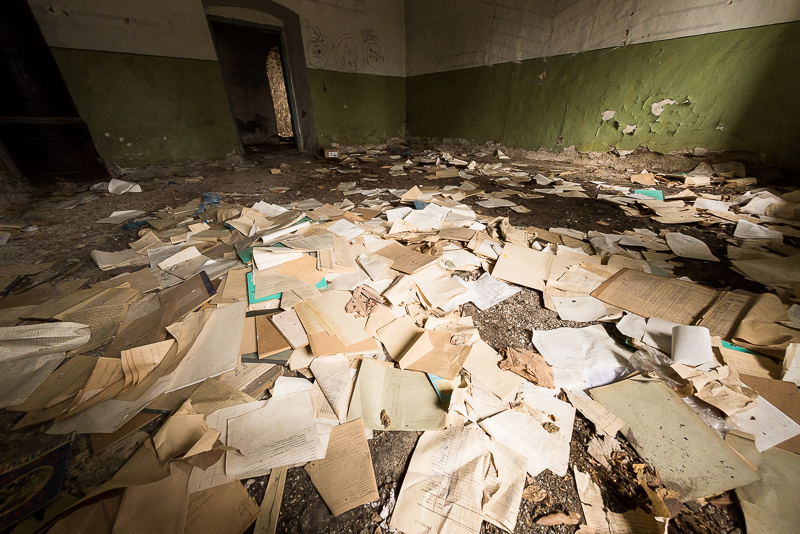
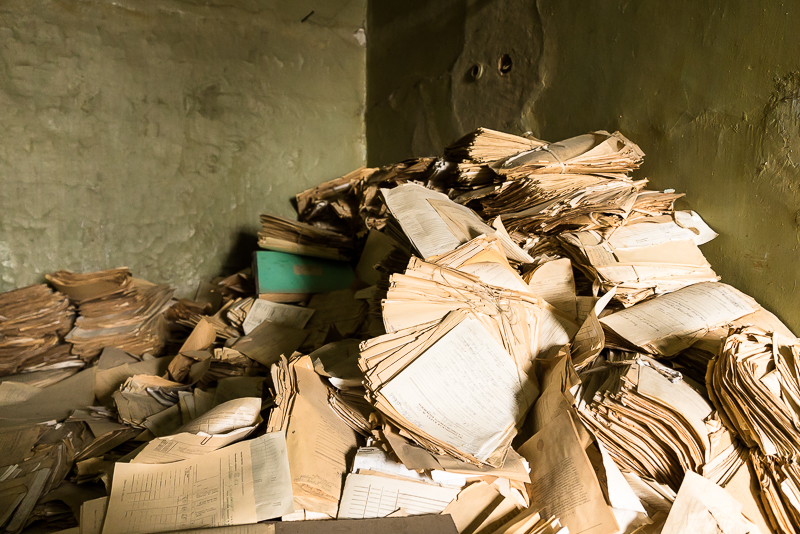
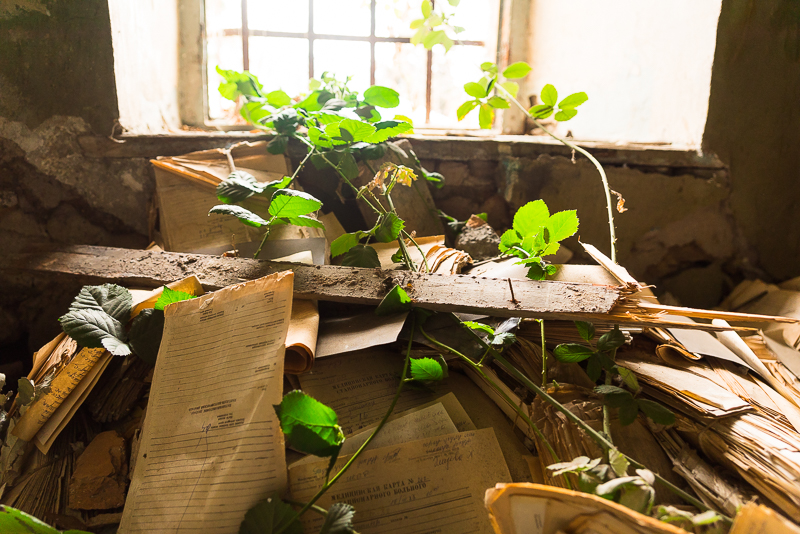
Mummified stacks of yellow paper carpet the floors. Strangely preserved, typed in Russian and beyond my basic level of comprehension.

150501-sheki-abandoned-childrens-hospital-blog-discovery-lotsofpaper-1

150501-sheki-abandoned-childrens-hospital-blog-discovery-lotsofpaper-2

150501-sheki-abandoned-childrens-hospital-blog-discovery-lotsofpaper-stack-1

Trying to decipher the text frustrates me, as I am not sure I know what I’m supposed to feel without knowing what was here. So what was all of this paper? As I look I see more, items with colour and faces and animals, things that look like they’d belong in a school.

And it’s frustrating when evidence is contradicting – I see dates spanning decades. When did they last teach schoolkids here?

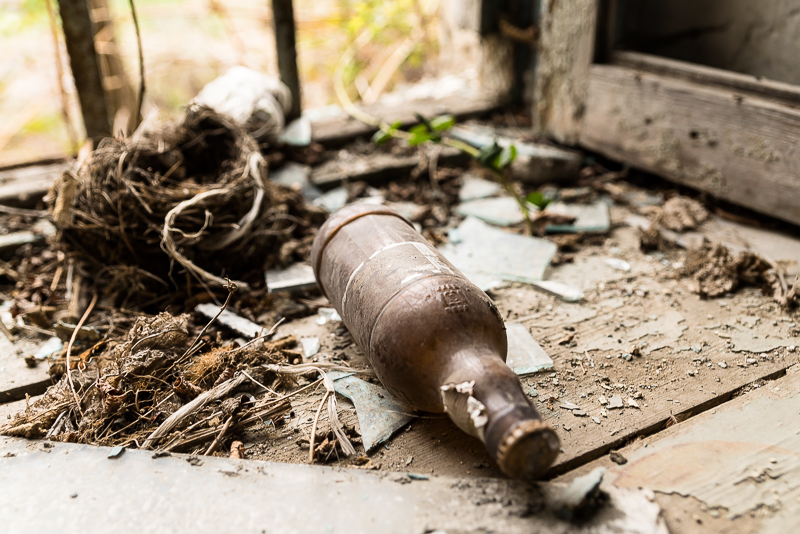
This mess of bottles forces you to imagine a lonely drinker’s breath. They must have held vodka, an extraordinary amount of vodka.

These are not booze bottles.

These are not booze bottles.

But I don’t see the bottles, I see people sitting in the dark drinking from them. There was nothing strange except for the sheer quantity, nothing unusual as I’ve seen evidence of vodka in the previous abandoned things I’ve explored in Azerbaijan.

But I look closer at the sparkling pile of glass and then it hit me–these bottles were never meant to hold booze, and this building was never a school.

And it’s those realisations that make an abandoned place unsettling.

It’s strange how once you realise the truth, you see all of the evidence contradicting your earlier beliefs so much more clearly. Now I see all sorts of things popping out vividly that give away the fact that this was not a building of education, but rehabilitation:

And now it’s officially creepy. You can’t help but see everything in a different light.

It’s not a toilet or shower, it’s torture chamber:

An abandoned bathroom / shower room in an abandoned children's hospital in Sheki, Azerbaijan. Nicholas Orloff Photography.

It’s not rubble, but gravestones:

Rubble in an abandoned room in a hospital, seen by Nicholas Orloff.

And you start seeing faces.

Nicholas Orloff Photography - two windows simulating a face in an abandoned hospital.

And speaking of light, after spending an hour in this place, wading through records and medical supplies and my brain hurting from thinking of what used to happen to the child patients, I needed to see light, the sky, anything. I hurry to suck in the smell of the freedom of outdoors and the scent of grass. And whilst I walk the grounds, I find one cannot escape the creep factor of this place.

Frown face painted on a windowsill in an abandoned children's hospital in Sheki, Azerbaijan. Nicholas Orloff.

But I cannot part with this experience just yet, and spend some more time walking about, in and out of the building. And the closer I look, I find it’s not rusty equipment and grungy rooms, the place does have some life and beauty to it.

After all…

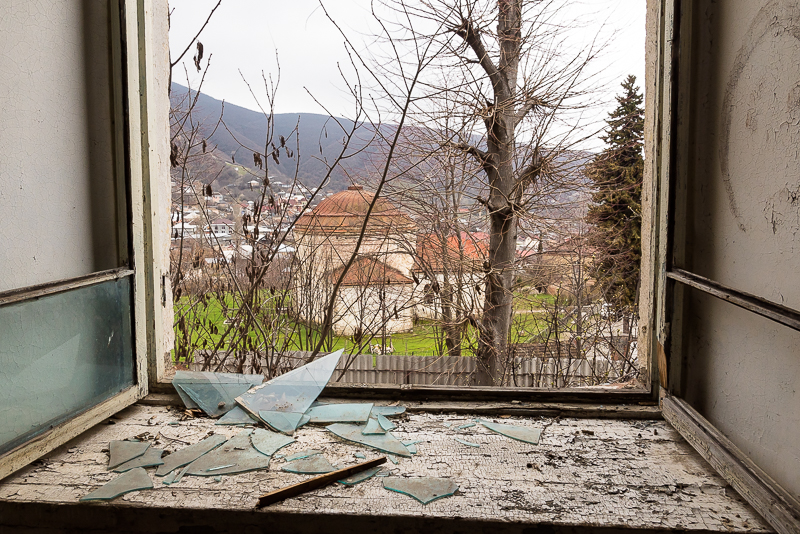
the view is nice…

Broken glass by a window in an abandoned hospital. Nicholas Orloff.

it has indoor gardens…

Green plants growing in a windowsill in an abandoned children's hospital, Sheki - Azerbaijan. Nicholas Orloff.

animals graze in the courtyard…

150501-sheki-abandoned-childrens-hospital-blog-sheepgrazing-1

and children have returned.

Children playing on the grounds of an abandoned children's hospital in Sheki, Azerbaijan. Nicholas Orloff.

Urban exploration is best experienced in person. And if you’re ever in Azerbaijan (which I really think you should at least once) you can go to Sheki (which I highly recommend) and see this place for yourself. You can find it at 41°12’15” N 47°11’50” E, right next door to the Palace of the Shaki Khans.

What about you? Do you like photographing and exploring abandoned buildings? Please share any stories and photos in the comments section.

Categories
gear nature

Sony A7s light sensitivity test

Yesterday was my last day in Longyearbyen. I spent it walking around the shores of Isfjorden photographing things in the dark with my Sony A7s. I haven’t had a chance to test for myself just how good it is in the dark, so I gave it a try. I applied no exposure compensation or brightening to these images.

All were shot at 25,600 ISO.

I was pretty impressed!

Categories
exploration history travel

abandoned mine exploration in the arctic

Mine 2B viewed from ground level - taken by Nicholas Orloff in 2014, Svalbard.

Mine 2B

Several days ago I climbed a mountain in the Arctic to explore Mine 2B, which has been abandoned since 1969. In Svalbard, it is law that anything made by humans before 1946 must be protected; nothing can be touched or removed. Combined with the cold, dry climate, this creates fantastic opportunities to catch a glimpse of mining life half a century ago.

Located above the tiny settlement of Nybyen, it’s a steep and slippery climb. This past week it was unusually warm, which resulted in the snow melting and refreezing. So I had to be careful.

Mine 2B, seen as approaching during ascent. Taken by Nicholas Orloff in 2014, Svalbard.

The mine becomes more intimidating as you ascend.

The climb is worth the effort for the view of Longyearbyen alone. This is the only area outside the “polar bear safe zone” that you can get away with venturing to on your own. In 1995, two tourists ignored advice from the locals and hiked up to Platåberget, the mountain you can see to the left in the next picture. Up top, where one would least expect it, a polar bear attacked them. One of them died. I was however, putting a lot of faith into the idea that I wouldn’t find a polar bear inside this structure.

View of Longyearbyen, Platåberget and Isfjorden. Taken by Nicholas Orloff in 2014, Svalbard.

View of Longyearbyen, looking out from the entrance to the mine.

I was creeped out as soon as I made it inside. The four month long polar night just started, so you only have a dim, grey-bluish soft light coming from a sun below the horizon for three hours a day. When you turn your back from the view, this is what you’re faced with:

The main "hall" of Mine 2B, immediately inside the entrance. Taken by Nicholas Orloff in 2014, Svalbard.

Reminiscent of whichever horror movie you’d prefer not to think about.

It’s cold, dark and noisy–outside the wind howls, whistles and invades every hole and crack in the walls. Doors bang, ropes and hooks swing about and wood creaks whether you step on it or not. I had the foresight to pack a photographer’s LED flood lamp for this trip, which attaches to my camera’s hotshoe. It wouldn’t have been possible to explore and concentrate on photography without it, so it was worth its weight in carry-on baggage allowance.

The building is over run with ice:

When I reached what looked like a dead-end the far end of the first level, I opened a door and found this staircase:

Staircase leading up to the second level of Mine 2B. Taken by Nicholas Orloff in 2014, Svalbard.

Many other horror movies came to mind.

As you ascend and explore different rooms, you find machinery frozen in mid operation:

Abandoned rooms, all with different purposes lie hidden in nooks and behind doors:

Tools, clothing and equipment lay undisturbed for half a century:

After an hour or two alone in this place, you start going strange and hear voices. It’s something to do with being alone in ruins sitting on a frozen mountain in one of the remote places on earth. I kept thinking, “am I actually alone in here”?

When you reach the third level of the structure, you must squeeze out of a door half frozen shut and you come across a plank bridge that connects to an adjacent building.

A rickety plank bridge spanning two buildings of Mine 2B. Nicholas Orloff Photography.

You have two choices–cross or turn back.

Of course, I crossed it. But then I had my final test:

A steep ladder you must climb to reach the top building of Mine 2B. Nicholas Orloff Photography, 2014.

Covered in ice and rotting, you must climb on all fours.

But when you reach the top, you’re rewarded with views like this:

A view of Longyearbyen from the opening of Mine 2b - taken by Nicholas Orloff. But climbing back down is a lot more difficult…

View from the very top of the Mine 2B complex.

My foot is in the shot for a sense of scale.

On the way down, I found this corridor to the other side of the mountain. The floors are rotten and you need to cross with great care:

A corridor with tracks leading to the mine shaft.If you look along the middle of the floor, you see metal tracks. This is how coal was transported from the mineshaft to the building for processing. Then it was loaded on cable cars and transported to the harbour. I walked towards the light and found an entrance to a mine shaft. It’s long been sealed: first by human bricks, then by nature’s ice:

I spent about three hours inside the mine, as this was quite possibly a once in a lifetime opportunity. It’s anybody’s guess to when (not if) it is destroyed, whether by the ice, an avalanche or even fire. I mention fire, for the original mine (mine #2) was set alight in 1944 by German sailors and continued to burn for twenty years.

It was getting dark(er) outside, so I decided to get out of this mine and off the mountain. As made my way to the exit, I spotted a nook that I somehow missed:

A nook in the Mine 2B structure, which was reserved for pin-up girl photos.

I made my way over the ice-flooded floor and realised that the rotting papers on the wall were something special. I found, quite literally, the human faces that proved this was somewhere living, breathing people spent the majority of their waking lives.

I’m sure that they helped the miners keep warm during their long days inside this Arctic mountain.


Categories
history tourism

hms victory

Nicholas Orloff - Photography taken at HMS Victory in England, UK. Previously I wrote about travelling in your own country.

Friends and family visiting from far away are great opportunities to play tourist in your own land. This past weekend my father came to visit all the way from California. I enjoyed catching up with him and seeing England from a visitor’s point of view.

Being a tourist is not necessarily a bad thing, as there are plenty of attractions that are worth visiting. Our first stop was Portsmouth, England to tour the HMS Victory. It’s hard trying to photograph heavily visited attractions in a new light. Or in this case, in an extreme lack of light, as it is quite dark inside. I think it’s deliberately kept that way to recreate the experience aboard over 200 years ago. I anticipated it would be quite tight inside as well, so I brought along a fish-eye for good measure.

Here’s a selection from that afternoon:

Categories
hiking nature travel

the benefits of slow travel: the south downs way

Nicholas Orloff self-portrait - along the South Downs Way.

I took this photo of me all by myself.

You can have an adventure without leaving your country. You can explore, meet interesting people, get lost and see where you live through the eyes of a tourist experiencing for the first time. The trick is to do something radically different from what you do day-to-day in your “normal life”.

In July 2014 I was itching for a trip, but for various reasons going abroad wasn’t practical. So I hiked the entire South Downs Way instead. My wife can’t understand why walking over 120 miles in seven days appeals to me. Well, I have several reasons.

The slower you travel, the more you think about what you see. It’s a bit metaphysical, but you wind up traveling inside your head. You can’t avoid introspection if you’re walking 12 hours a day by yourself. To help you think, you have three things to look at: the ground, the clouds, and farm animals.

1) Below the horizon: the ground
The South Downs Way runs through 100 miles mostly of chalk grasslands, farms and hills. So it’s repetitive. But you quickly learn to appreciate little details that diversify your view:

2: Above the horizon: clouds
Almost any photo can be improved with clouds. Clouds make everything look dramatic. Not only do they keep the harsh sunlight off your subject, they cast shadows, break up the monochrome sky, and refract and reflect light.

Examples:

Dramatic herd of sheep - taken by Nicholas Orloff in summer of 2014.

Dramatic herd

Dramatic gull in the clouds  - taken by Nicholas Orloff in summer of 2014.

Dramatic bird

Dramatic poppies - taken by Nicholas Orloff in summer of 2014.

Dramatic crops

Dramatic rust - taken by Nicholas Orloff in summer of 2014.

Dramatic rusty thing

3: In between: farm animals
If you walk this trail alone (and in my opinion, you should), even cattle start appearing dramatic:

Eventually, sheep and cows start talking to you. It usually happens after walking twenty miles on four hours of sleep.

SDW2014-529

I don’t believe we’ve met.

And who do you think you are?

It’s not all great fun for animals though. You’ll pass right through a pig farm outside of Steyning, East Sussex. Pigs get a bad deal and live in forced labour camp conditions.

SDW2014-939

Dystopia

You start going a bit strange and thinking about how there can’t be beauty without pain, and all of that stuff.

The trifecta

My best photos on this trip resulted from combining clouds and animals with a sharply contrasting foreground. This is epic stuff, and it almost always happens when a storm approaches:

Nicholas Orloff - The South Downs Way Sheep

Dramatic birds
There you have it. Travel slowly, study closely, observe simplicity and find beauty. You know you’re doing it right when strange but wonderful things happen.

It happened to me on the last night of this trip in Alfriston, East Sussex. I was walking back to the hostel after dinner and literally was pulled into an art gallery exhibition before a heavy storm hit. I wound up photographing it for the artists, and got some free food out of the deal. It’s moments like those you find along your journey that you didn’t know you were searching for.

And riding these moments to conclusion sets you up for catching photos like these:

It only took me walking 100 miles over six days to catch this shot.

So what are you waiting for? Get walking!

Bonus:
Play around with this interactive map to follow my journey and see more photos where they were taken:

Map not displaying properly?

Categories
graffiti

split, croatia graffiti

Categories
cats

cats of split, croatia